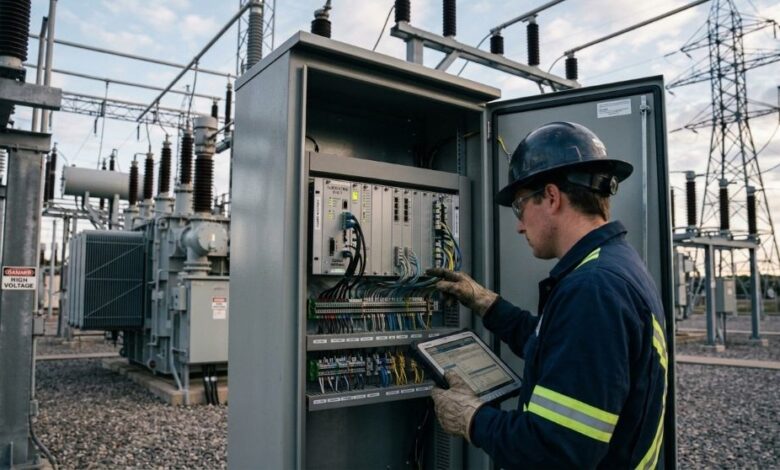
Remote terminal units (RTUs) in substations form the digital connection between physical grid equipment and the control room. They collect information from switchgear, protection relays, meters, transformer sensors, fault indicators, and auxiliary systems, then transmit structured data to SCADA. They also receive authorised commands and convert them into controlled actions at the site.
The Role Of A Remote Terminal Unit
This role is more complex than simple data transmission. A substation may contain modern Ethernet devices, serial equipment, hardwired contacts, and products installed during different stages of the network’s development. The RTU must combine these sources while preserving timestamps, alarm states, measurement quality, and command status.
When a breaker changes position or a protection relay detects a fault, the RTU records the event, applies configured logic, and sends the information to SCADA. If the communication link is temporarily unavailable, a capable device can store time-stamped events and forward them after the connection returns. This allows operators and engineers to reconstruct what happened instead of receiving several delayed events without context.
How RTUs Support Communication Between Different Systems
RTUs in substations also support communication between systems that use different protocols. Common examples include IEC 60870-5-101, IEC 60870-5-104, IEC 61850, DNP3, and Modbus. Effective protocol conversion must preserve engineering units, data quality, timestamps, alarm priority, and command behaviour. Without these details, SCADA may display a value that appears correct but is old, substituted, or invalid.
Local automation is another important capability. Depending on the project, an RTU may perform interlocking, alarm processing, calculations, automatic switching, or other control functions. These tasks can continue even when communication with the control centre is lost. Local and remote operating modes should be clearly defined to prevent conflicting commands and unsafe actions.
Cybersecurity and RTUs
Cybersecurity is essential because an RTU can influence physical equipment. Suitable controls include network segmentation, role-based access, secure remote administration, firmware validation, audit logs, and the ability to disable unused ports or services. Utilities should also maintain tested backups and documented restoration procedures. Security is not only about preventing access; it is also about recovering safely after a failure or incorrect update.
What Must be Checked Before Choosing an RTU?
Reliable commissioning requires more than checking whether points appear on a SCADA screen. Engineers should test command execution, communication recovery, time synchronisation, invalid values, power interruptions, and event bursts. Clear point lists and configuration records make future maintenance easier. Technical information about a modular grid automation RTU is available online from Elseta, showing how communication, measurements, fault indication, and remote control can be integrated.
Scalability should also be considered. The selected RTU should accommodate additional feeders, sensors, and communication links without forcing a complete system replacement. Modular hardware and reusable configuration templates can reduce engineering effort across multiple sites. This makes fleet-wide diagnostics faster and helps operators identify failing devices before communication problems develop into unexpected, costly service interruptions.
A Dependable Link for Modern Grid Operations
Well-designed RTUs in substations provide more than connectivity. They maintain the meaning of field data, support safe remote control, enable local automation, and create useful diagnostic records. When protocol support, cybersecurity, commissioning, and lifecycle maintenance are addressed together, the RTU becomes a dependable foundation for efficient and resilient grid operation at scale.