Industrial facilities across the UK, from chemical manufacturing plants and metal finishing shops to wastewater treatment works and pharmaceutical laboratories, face an increasingly rigorous regulatory environment when it comes to airborne emissions. The release of toxic gases, acid vapours, chlorine compounds, hydrogen sulphide, and fine chemical particulates into the atmosphere is subject to strict environmental permit conditions, COSHH regulations, and Health and Safety Executive requirements. Failing to meet these standards carries serious consequences: enforcement notices, operational shutdowns, reputational damage, and in the most severe cases, prosecution. Against this backdrop, industrial wet scrubbers have become one of the most trusted and widely deployed tools in the air pollution control engineer’s toolkit. Capable of removing a broad spectrum of gaseous and particulate contaminants with efficiencies reaching 99.99%, the right scrubber system transforms a compliance liability into a manageable engineering challenge,and this guide explains exactly how they do it.
What Is an Industrial Wet Scrubber?
An industrial wet scrubber is an air pollution control device that removes contaminants from a process gas or exhaust air stream by bringing the polluted air into direct, intimate contact with a scrubbing liquid, most commonly water or a chemical solution tailored to neutralise the specific contaminant present. As the contaminated air passes through the scrubbing liquid, target pollutants are absorbed into the liquid phase, where they are neutralised or held in solution. The treated air, now substantially free of contaminants, exits the scrubber and is safely discharged to atmosphere.
The chemistry of the scrubbing liquor is selected specifically for the pollutant being treated. Acidic gases such as hydrogen chloride (HCl), sulphur dioxide (SO₂), and chlorine (Cl₂) are typically scrubbed with a caustic (alkaline) solution such as sodium hydroxide, which neutralises the acid on contact. Alkaline gases such as ammonia (NH₃) are treated with an acidic scrubbing liquor. Hydrogen sulphide (H₂S), responsible for the characteristically unpleasant odour at sewage works and rendering plants, is abated using oxidising or alkaline scrubbing chemistry. This chemical flexibility is one of the key reasons wet scrubbers are found across such a wide variety of industries.
Fibre Reinforced Plastic (FRP) is the dominant material of construction for industrial scrubber systems. Its outstanding resistance to chemical corrosion, low weight compared to steel, UV stability for outdoor installations, and long service life under the harshest chemical conditions make it the material of choice for vessel shells, sumps, pipework, and internal components. High-grade thermoplastics, including PVC, CPVC, and polypropylene, are used for internals and fittings where FRP’s properties are complemented by ease of fabrication or a specific chemical compatibility requirement.
Packed Bed Scrubbers: The Core Technology
The most widely deployed category of industrial wet scrubber is the packed bed scrubber, also known as a packed tower. At its heart is a bed of structured packing media housed within the scrubber vessel. The purpose of this packing is to create an enormous surface area within a compact volume, over which the contaminated air and the scrubbing liquid interact continuously as they flow through the bed.
The selection of packing media has a profound impact on both performance and running cost. Advanced packing geometries, such as modern polycube-style designs, achieve far greater mass transfer per unit of liquid flow than older, conventional packing types. In practical terms, this means a well-specified modern packed bed scrubber may require as little as 2 gallons per minute of scrubbing liquid per square foot of packing cross-section to achieve target removal, compared to 6–8 GPM/sq.ft demanded by older designs. Over the operational lifetime of a system, this reduction translates into very significant savings in water consumption, chemical dosing costs, effluent disposal, and pump energy, making the choice of packing media a genuinely important economic decision, not merely a technical one.
Horizontal Scrubbers: Crossflow Configuration
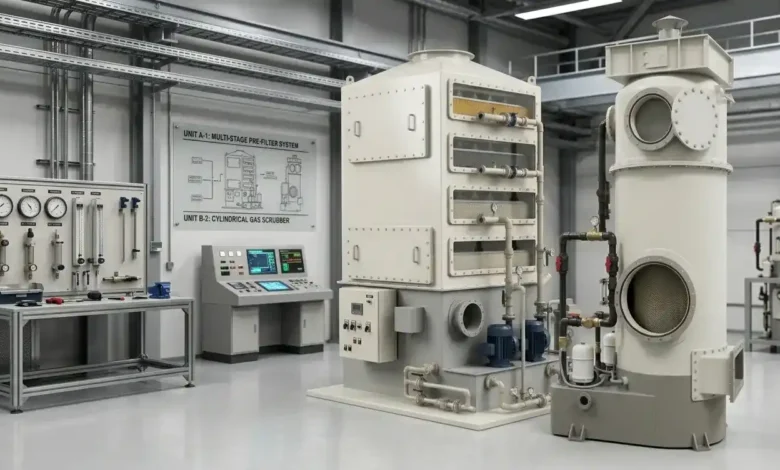
A horizontal scrubber, technically a crossflow scrubber, is oriented so that the contaminated airstream travels horizontally through the packed bed, while the scrubbing liquid flows downward under gravity through the same packing. These two streams therefore travel at right angles to each other, which is the defining characteristic of the crossflow design.
When to Choose a Horizontal Scrubber
Horizontal scrubbers are the preferred choice in several specific installation scenarios:
Space-constrained environments. The horizontal vessel orientation means these units have a very low profile, making them suitable for installations where overhead clearance is limited, plant mezzanines, basement-level process areas, or rooftop installations under structural constraints. They can often be sited where a vertical tower of equivalent capacity would simply not fit.
Retrofit installations. When adding emission control to an existing facility where structural modifications are impractical or cost-prohibitive, the compact footprint and flexible mounting options of a horizontal scrubber make integration far more achievable than a tall vertical tower.
Lower pressure drop applications. The crossflow arrangement generates a lower static pressure drop across the scrubber bed compared to an equivalent counter-current vertical design. This reduces the duty requirement on the exhaust fan, lowering both capital cost and ongoing energy consumption, particularly relevant in large-volume ventilation applications.
Acid digestion and moderate-duty odour control. Horizontal crossflow scrubbers are widely used for acid vapour abatement in laboratory exhausts, chlorine scrubbing in water treatment facilities, and odour control in food processing and agricultural applications where the inlet concentration is moderate and the crossflow efficiency is sufficient to achieve compliance.
Key design parameters to specify include the active packing cross-sectional area (which governs maximum volumetric airflow), the packing depth in the direction of air travel, the scrubbing liquid distribution system, the recirculation pump duty, and the provision for pH monitoring and chemical dosing
Vertical Scrubbers: Counter-Current Configuration
A vertical packed bed scrubber, the counter-current tower, stands upright. Contaminated air enters at the base and rises upward through the packed bed, while scrubbing liquid is introduced at the top of the bed and flows downward under gravity, directly counter to the rising gas flow. This counter-current arrangement is the most thermodynamically efficient configuration for gas absorption available in industrial scrubber design.
Why Counter-Current Flow Matters
The fundamental advantage of counter-current contact is its inherent concentration gradient. At the top of the packing, the cleanest incoming scrubbing liquid meets the nearly clean outgoing gas, maintaining a strong driving force for mass transfer at the point where the outlet concentration must be minimised. At the base of the packing, the most contaminated inlet gas meets the partially spent scrubbing liquor, acceptable because the concentration difference remains large enough to sustain absorption. This gradient is maintained throughout the full depth of the bed, maximising the utilisation of both the packing volume and the scrubbing chemical, and delivering the highest achievable removal efficiencies.
Applications of Vertical Scrubbers
Odour control at wastewater and sewage treatment works. Hydrogen sulphide and other odorous compounds at sewage treatment sites, pumping stations, and sludge processing facilities are among the most demanding odour abatement challenges in the water industry. Vertical counter-current scrubbers, often operating in two stages, an acid pre-wash stage followed by an alkaline scrubbing stage, are the standard engineering solution for H₂S removal to the sub-parts-per-million concentrations required by environmental permits.
Sulphur dioxide (SO₂) abatement. Power generation, waste incineration, and industrial combustion processes generating SO₂ in flue gases rely on counter-current scrubbing to achieve compliance with increasingly strict atmospheric emission limits.
Chlorine scrubbing. Chemical manufacturing, water treatment chlorination facilities, and pulp and paper mills use vertical scrubbers as both routine emission control devices and safety-critical emergency absorption systems for catastrophic chlorine gas release scenarios.
Chrome and acid mist abatement. Metal plating, anodising, and electropolishing operations generate acid mists and, in hard chrome plating, hexavalent chromium aerosols that are subject to extremely stringent occupational exposure limits and environmental emission standards. Vertical scrubbers, often paired with high-efficiency mist eliminators, are the engineering standard for these applications.
Multi-stage and high-efficiency designs. Where single-stage removal is insufficient to achieve regulatory targets, vertical scrubbers can be designed as multi-stage units with independent packed beds in series within a single tall vessel, or as separate sequential towers. Complete factory-assembled, factory-tested systems, including controls packages, instruments, and start-up provisions, are available to minimise on-site commissioning risk.
Choosing Between Horizontal and Vertical: A Practical Summary
Neither configuration is universally superior, the right choice depends entirely on the specific requirements of each installation. As a practical guide:
Choose a horizontal scrubber when space height is limited, pressure drop must be minimised, or the installation is a retrofit into an existing facility with constrained structural options. It excels in moderate-duty acid, chlorine, and odour abatement applications.
Choose a vertical scrubber when maximum removal efficiency is required, inlet gas concentrations are high, regulatory standards are demanding, or the application involves hazardous contaminants such as H₂S, SO₂, chlorine, or chromium mists. Its counter-current design delivers the highest performance the technology offers.
In both cases, the quality of the FRP construction, the selection of packing media, the design of the liquid distribution system, and the integration of appropriate mist elimination and fan equipment will determine whether the installed system delivers long-term compliance, low operating cost, and genuine reliability.
Conclusion